
The quick answer
To improve communication in a dental practice, stop relying on people to read one another's minds. Set clear expectations, agree on repeatable handoffs, ask the team what support they need, and make it safe to raise a problem early. Review those habits every day instead of waiting for a conflict, a patient complaint, or a difficult team meeting.
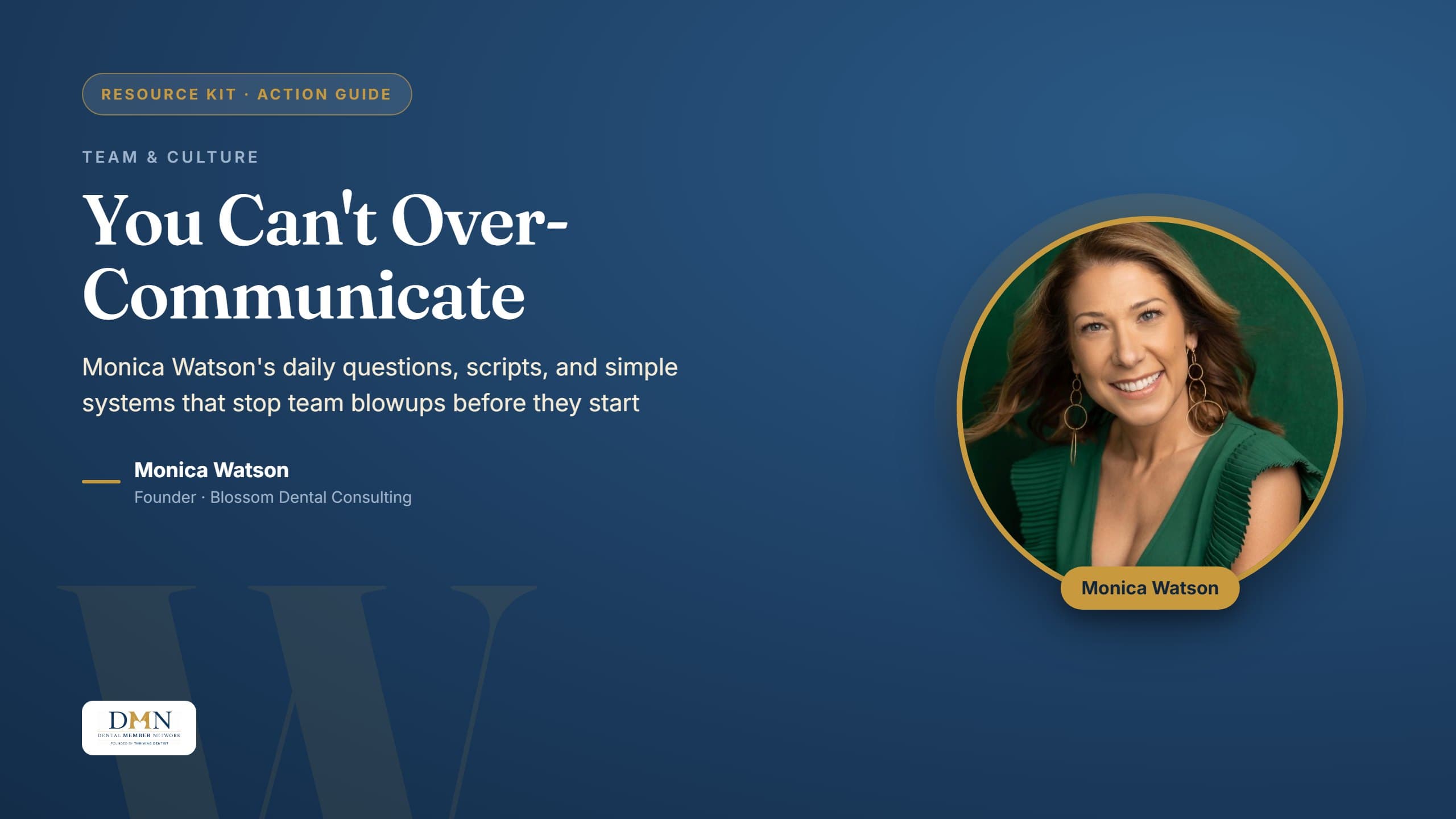
Monica Watson puts the principle plainly: "You can't over communicate. You can only under communicate."
That does not mean adding more messages, meetings, or software. It means making the important information clear, timely, consistent, and useful to the person who needs it.
Why dental-team communication breaks down
A dental practice moves quickly. The front desk is answering calls, checking benefits, managing the schedule, and helping patients. The clinical team is moving between operatories, preparing treatment, documenting care, and responding to the doctor. Each person may be doing their own job well while the practice still creates gaps between roles.
Those gaps show up in familiar ways:
- An emergency patient is added without the clinical team receiving the right details.
- The doctor is running behind, but nobody explains the delay to the next patient.
- A team member is held accountable for an expectation that was never clearly stated.
- The front and clinical teams explain the same procedure differently.
- A small concern stays quiet until it becomes a personal conflict.
The fix is not simply telling everyone to communicate better. The practice needs a few defined communication systems that remove ambiguity.
1. Replace firefighting with a morning plan
Monica encourages practices to plan for predictable pressure before the day becomes stressful. During the morning huddle, identify likely trouble points:
- Where will an emergency patient fit?
- Which appointments may require extra time or support?
- Where is the schedule especially tight?
- Who will update a waiting patient if the doctor falls behind?
- What information needs to move from the front desk to the clinical team?
This is not a long meeting. A focused huddle gives the team a shared picture of the day and reduces the number of decisions made in a rush.
2. Make expectations visible
Monica says, "Clarity is kindness."
Team members need to know what good performance looks like, who owns each task, and when a handoff is complete. If the expectation exists only in the practice owner's head, accountability will feel unpredictable and unfair.
Choose one recurring point of friction and write down:
- What needs to happen.
- Who is responsible.
- What information must be recorded or handed off.
- When the task is considered complete.
- What happens if the normal process cannot be followed.
Start small. A clear one-page process for emergency calls or late-running appointments is more useful than a large manual nobody uses.
3. Use a complete front-to-back handoff
When an emergency patient calls, the front desk should not have to invent the questions. Monica recommends an intake form with a consistent script.
The form might include:
- What prompted the call?
- Where is the discomfort?
- When did it begin?
- Has anything made it better or worse?
- Is there swelling, trauma, or another urgent concern?
- What has the patient already been told about the visit?
The clinical team then receives the information before the patient is seated. The front desk should also set an honest expectation: the practice will address the immediate concern, but definitive treatment may require diagnosis, time, and a separate visit.
The exact clinical questions and urgency rules must be approved by the dentist. The communication principle is universal: the person receiving the handoff should not need to start from zero.
4. Ask a daily support question
Monica recommends that team members ask one another:
"How can I support you today?"
This question works because it turns a vague idea of teamwork into a specific offer. A dental assistant may need the front desk to protect a handoff window. The scheduling coordinator may need the doctor to make a decision before lunch. A new employee may need clarification without feeling that they are slowing everyone down.
The answer is not always a request for more help. It may reveal a missing resource, an unclear responsibility, or a conflict that can be addressed while it is still small.
5. Make it safe to give an honest answer
Asking for feedback is not enough. Leaders also have to show that an honest response will be handled constructively.
Monica warns that when a team stops talking to its leader, the culture is already in trouble. If questions are dismissed, concerns are punished, or every suggestion becomes a debate, people learn to remain quiet.
Leaders can change that pattern by responding with three steps:
- Thank the person for raising the issue.
- Ask for a specific example and the impact it created.
- Agree on the next action, owner, and follow-up date.
Not every suggestion must be accepted. Every sincere concern should receive a clear response.
6. Give patients one consistent explanation
Communication gaps affect patients too. Monica recommends creating a benefit statement for every common procedure so the patient receives the same basic answer from the front desk, assistant, hygienist, and doctor.
The statement should explain, in plain language:
- What problem the procedure addresses.
- Why the dentist may recommend it.
- What the patient should ask the clinical team before deciding.
The doctor still provides the diagnosis, risks, alternatives, and informed-consent discussion. The shared statement simply prevents different team members from giving conflicting or confusing explanations.
7. End new-patient calls with the comfort question
Monica teaches teams to ask:
"Is there anything you'd like us to know to make your visit more comfortable at our office?"
The answer may reveal anxiety, mobility needs, a previous negative experience, a preference for detailed explanations, or another useful detail. Record it and share it with the clinical team.
That single question tells the patient that the practice is listening before the appointment begins.
A simple weekly communication review
Once a week, ask the team:
- Where did information get lost?
- Which handoff worked especially well?
- What expectation remained unclear?
- Did a patient receive two different answers?
- What one process should we clarify this week?
Choose one improvement and test it. The goal is not a perfect week. It is a practice that notices communication gaps and repairs them before they become culture problems.
Frequently asked questions
How can a dentist improve communication with the team?
Set explicit expectations, define task ownership, use short daily huddles, ask what support people need, and follow up visibly when someone raises a concern.
What should a dental morning huddle include?
Focus on the day's pressure points, schedule risks, emergency capacity, important patient needs, handoffs, and decisions that require a named owner.
How can a dental practice reduce staff conflict?
Address concerns early, discuss the process and impact rather than attacking the person, clarify the expected behavior, and agree on a next step that can be observed.
The takeaway
Better communication is not more talking. It is fewer assumptions.
Plan for predictable problems, make expectations visible, use complete handoffs, ask useful questions, and protect the honesty you asked the team to give you.
Continue inside the membership
Get the complete You Can't Over-Communicate resource kit.
The member kit includes Monica's Action Guide, checklist, worksheet, wall poster, scripts, and team implementation resources.
Join Dental Member Network