
The quick answer
To prevent avoidable dental insurance claim denials, build one documented billing process that begins with eligibility verification and continues through accurate patient data, complete clinical notes, required attachments, claim review, submission, and follow-up. Train the team on that process before adding new software or automation. Track rejection and appeal reasons so the practice can correct the step that caused the problem.
DeVon Banks summarizes the principle clearly: "Technology is our tools. They're not the process."
The grammar is conversational, but the lesson is precise. A dashboard can reveal a denial. It cannot repair a workflow the practice has never defined.
Why denials begin earlier than most teams think
When a claim is rejected or denied, the billing team often focuses on the final submission. DeVon asks practices to look further upstream.
The problem may have started when benefits were not verified, patient details were entered incorrectly, the procedure note did not support the service, an attachment was missing, or nobody owned the follow-up. By the time the payer responds, the original error may be days or weeks old.
That is why the process needs to cover the full path from appointment preparation to payment.
1. Write the workflow before buying another tool
Start with a simple map of the current process:
- Verify eligibility and benefits.
- Enter or update patient and plan information.
- Confirm the planned procedure and coding information.
- Complete the clinical documentation.
- Gather required images, narratives, or other attachments.
- Review the claim before submission.
- Submit through the approved system.
- Track the payer response.
- Correct, appeal, collect, or escalate according to the result.
For each step, name the owner, the deadline, the required information, and the evidence that the task is complete.
DeVon makes the training problem obvious: "It's kind of difficult to promote training when there's not a system to train on."
2. Begin with eligibility verification
The billing process does not begin after treatment. It begins before the patient is in the chair.
Confirm the patient's current plan details and document what the practice learned. Eligibility and benefit information can change, and verification is not a guarantee of payment. It is still a necessary control because it helps the team identify plan limitations, missing data, and patient responsibility before treatment.
The American Dental Association advises practices to document details such as the carrier, group number, and member identification information during eligibility verification. The practice should also follow the payer's current rules and the terms of its participating-provider agreements.
3. Make the clinical note support the claim
Billing cannot repair documentation that never explains what happened clinically.
The note should accurately describe the patient's condition, the diagnosis, the service delivered, and any relevant clinical findings. Required radiographs, periodontal records, narratives, or other attachments should match the procedure and payer requirements.
This does not mean writing notes for an insurance company instead of the patient record. It means making the record complete enough to show why the care was necessary and what was performed.
The dentist remains responsible for clinical documentation. The billing team can use a checklist to identify missing elements before a claim leaves the practice.
4. Review the claim before submission
A short pre-submission review can catch avoidable errors:
- Does the patient's name and identification match the plan record?
- Is the correct payer and group information attached?
- Are procedure details complete and consistent?
- Does the clinical note substantiate the service?
- Are all required images, narratives, or other documents included?
- Has the team recorded any relevant coordination-of-benefits information?
- Is the claim being submitted through the correct channel?
The checklist should reflect the practice's services and the payer's current rules. It should not depend on one experienced employee remembering every exception.
5. Track the reason, not just the unpaid balance
An accounts-receivable report tells the practice what remains unpaid. It does not always explain why.
Create a simple denial and appeal log with fields such as:
- Date submitted
- Payer
- Procedure or claim category
- Rejection or denial reason
- Missing information
- Action taken
- Owner
- Follow-up date
- Final outcome
DeVon used a plain spreadsheet to review a few hundred appeals over about six months, identify patterns, and change processes. The exact volume is not the point. The habit is: collect enough consistent information to see where the workflow is breaking.
Review the log monthly. If one denial reason keeps returning, fix the upstream step instead of repeatedly correcting the same result.
6. Include patient collections in the same process
Getting paid includes both the insurance portion and the patient portion. DeVon warns that practices may focus heavily on the payer while leaving patient balances unresolved.
Before treatment, the team should explain what is known, what remains an estimate, when payment is expected, and which payment methods or financing choices the practice genuinely offers. After the payer responds, communicate any remaining balance clearly and promptly.
DeVon's standard is direct: "There should not be a patient in the chair that you're not aware of how you're going to get paid, both from insurance and from patient."
This is not a promise that every estimate will be exact. It is a requirement that the practice has checked the information available and has a defined financial conversation.
7. Train for consistency, then automate
Once the workflow is documented, train every person who owns a step. Use real examples, a skills check, and a short audit period. When the process works consistently, decide which technology can remove repetitive work or improve visibility.
Evaluate a tool against a specific problem:
- Which step will it improve?
- What input data does it require?
- Who monitors exceptions?
- How will the practice know it worked?
- What happens when the automation fails?
DeVon's warning is useful here: "You can't just spend away a problem."
A 15-minute monthly claims review
Bring the practice owner, clinical lead, and billing owner together and answer:
- What were the most common denial or rejection reasons?
- Which step caused each recurring problem?
- Are clinical notes or attachments regularly incomplete?
- Are eligibility details being recorded consistently?
- Which patient balances have no next action?
- What one process change will we test this month?
Assign an owner and a review date. A meeting without a process change is only a report.
Frequently asked questions
What causes dental insurance claims to be denied?
Common causes include eligibility problems, inaccurate patient or plan data, incomplete clinical documentation, missing attachments, coding or submission errors, plan limitations, and missed follow-up requirements.
Does verifying benefits guarantee payment?
No. Verification helps the practice understand available information, but it is not a guarantee of payment. Benefits, eligibility, payer policies, and contract terms can affect the final decision.
Should a dental practice buy claims software first?
Document the process first. Then choose technology that improves a defined step, uses reliable data, and has a named person responsible for exceptions and follow-up.
The takeaway
The best time to prevent a denial is before the claim leaves the practice.
Verify benefits, keep patient data accurate, document the care completely, attach what the payer requires, review before submission, and track recurring reasons. Build the process first. Use technology to strengthen it.
Continue inside the membership
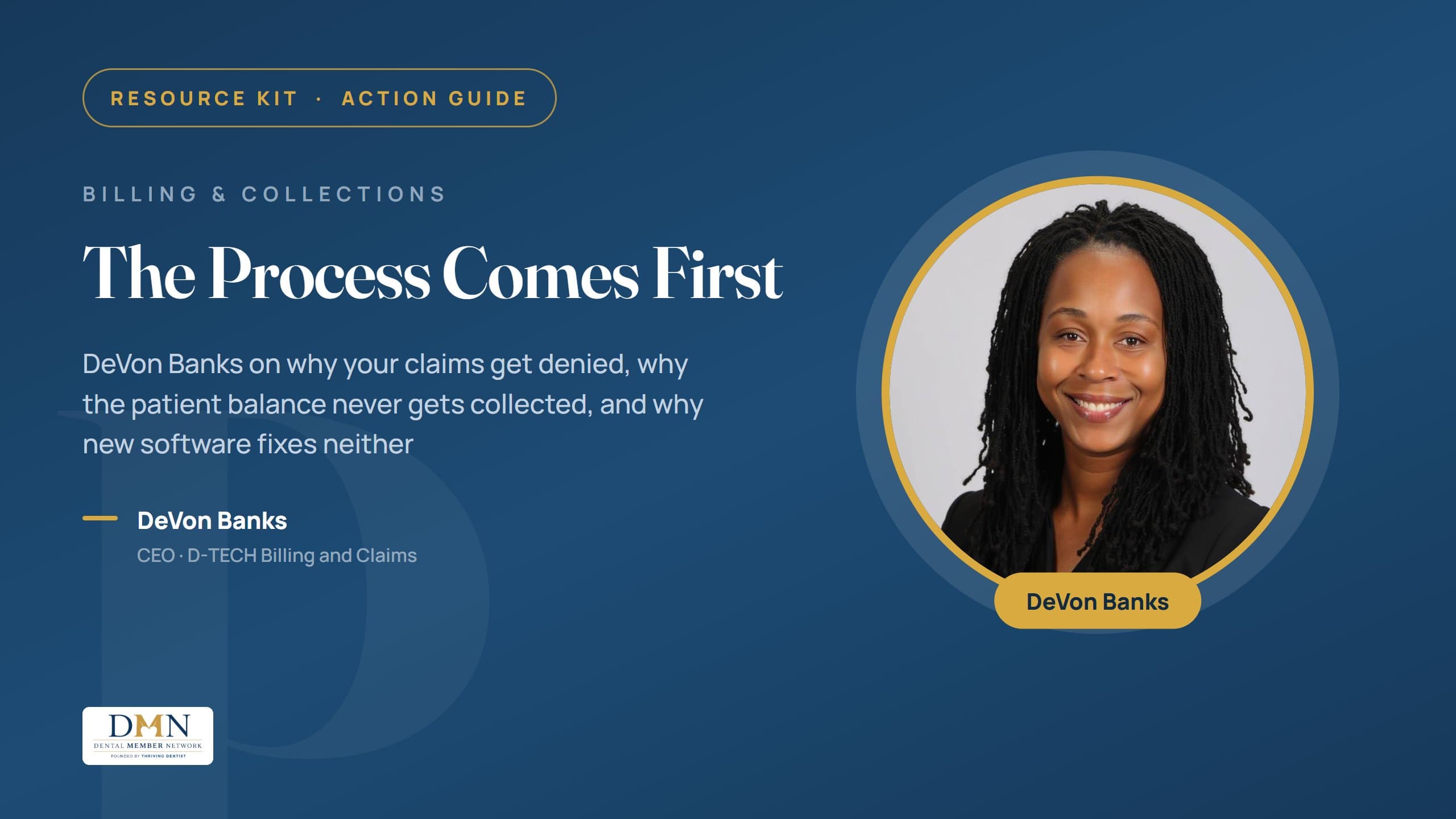
Get the complete The Process Comes First resource kit.
The member kit includes DeVon's Action Guide, claims-process checklist, workflow worksheet, wall poster, and billing implementation resources.
Join Dental Member Network